MY WORKS SO FAR DIVIDE INTO FOUR PHASES. BUT I DO ALSO WORKS THAT EXTEND BEYOND THAT AND WORKS THAT ARE NOT BOUND BY THE LIMITS OF PHASES. THESE WORKS CAN BE VIEWED
VIEW MY DRAWING HERE AND B&W PHOTOGRAPHY HERE
PHASE 4 : BOOK-ARTS BASED WORK - 2009-NOW
PHASES IN DESCENDING ORDER BELOW- FROM THE LATEST TO THE EARLIEST
ARTIST'S STATEMENT ON PHASE 4
Publishers engage in commercialization of anti-environmental over supply, hence, more of their products end up as utter waste. To somewhat reverse that, I use leftover, untouched and trashed books/catalogs as my raw material and turn them into art works. Often I have 50 copies of the same catalog as an ‘edition’ but each copy is individually worked upon and has unique character maintained via manual work. I like my work to be treated on real world level and not as a prized element on an elevated pedestal of high art. So I allow viewers to pick them up like regular books for closer observation. As a result (when viewers put the books back), their display shape/size keep altering as if giving them their organic roots back.
THE NEWEST WORKS OF PHASE 4
The initial book project where the entire books are painted as individual art works is displayed after the first 21 newest images. The initial book art project is consisted of entirely painted books & all the pages of a book together stand as individual art works. Images representing that project are select pages that are only a part of larger works & not stand alone works. Unlike that, the first 21 images are individual pages separated from books before painting & painted as stand alone art works. These works are newly created during May - August 2013, long after the images that follow
this group.
PHASE 4 IMAGES
PAGES FROM THE INITIAL BOOK ART WORKS
Images below are
select pages that are integral part of various painted books. These are the images of select pages from entire books that are art works & these pages are only a part of the larger works.

PHASE 3 : INDIAN ICONOGRAPHY BASED WORK - 1991-2009
ARTIST'S SATEMENT ON PHASE 3
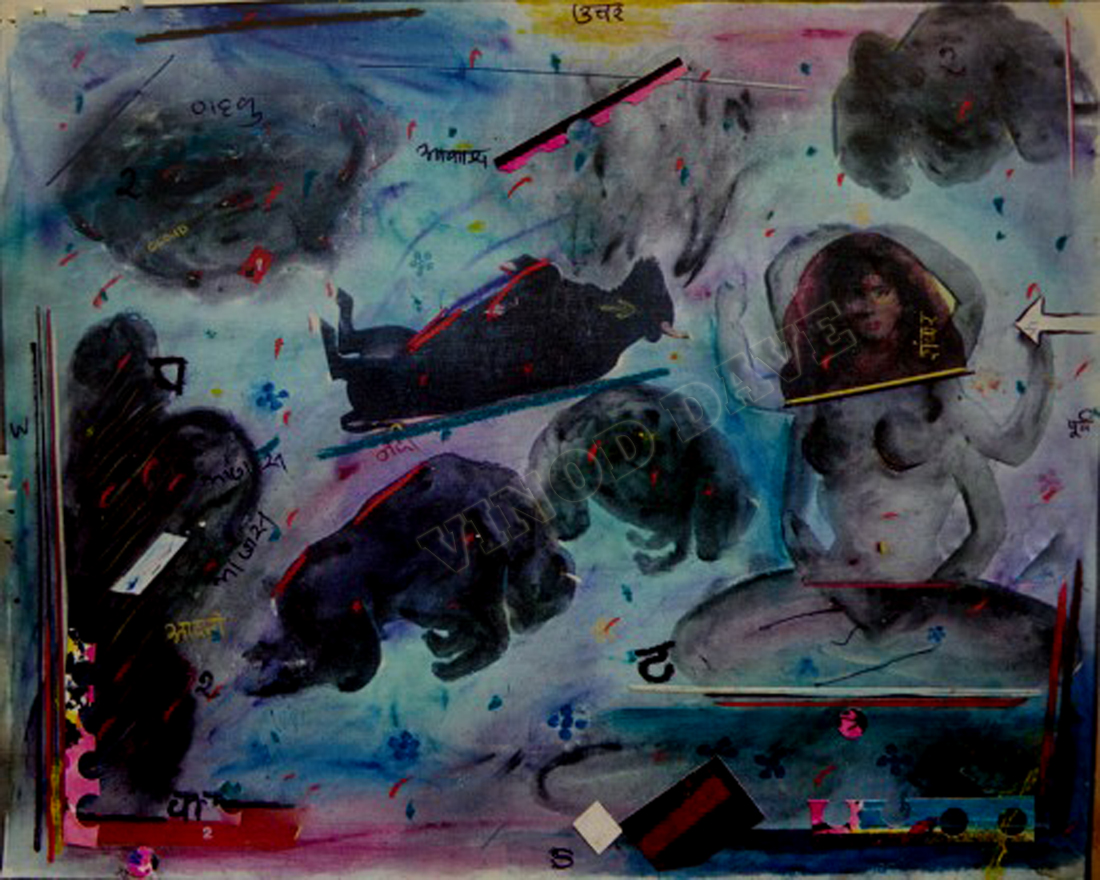
By interpreting popular images of deities into personal statements, I have both paid homage to and, like an ordinary human being, ‘quarreled with Gods’ by viewing them with contemporary sensibility and turning them into art of social context. I have always been fascinated by stories and images of legendary gods and demons including their miracles, strange wars, incredible flights and their multi-headed, multi-handed heavenly physique.
But my personal statement of social nature via deities is not a revolt and it is not aimed at change like in a movement. What I am trying to do more than anything else by painting this is to heighten the tension between the duality of existence. And the duality is that of the superior and the inferior. Though the images painted refer mostly to the superior, their paraphernalia make the invisible presence of the other party felt indirectly. It is about the tension that connects to a sense of violence, a violence that cannot be categorized; but it exists. And it exists between the powerful and the weak, the controller and the controlled, the master and the slave, the ruler and the ruled, the privileged and the deprived, the star and the masses, the special and the mundane.
My work is about conflict of the opposites. For me, it is also of physical/mental visions. With one seeing eye, I see without spatial distance.
I had two seeing eyes once and my mind remembers how I saw then. So, it still tries to see things that way and that creates a conflict of discomfort. I depict imagery by juxtaposing fluidly colored areas in contrast with solid thickly painted hard-edged shapes, marks and text to "fool" my mind into "seeing" depth. Thus, my personal conflict of partial disability resonates with the conflicts of life.
Coming from another culture and trying to live in different one is very conflicting. So for me personally, it is not only one conflict. Besides seeing differently and being aware of opposites in life, I face yet another challenge. I come from a tiny India village and now live in a western mega city. That adds to my awareness of how most people struggle to survive in the modern world despite difficulties. That sets the powerful clearly apart just like gods that most of us follow and worship without questioning. Maybe I am trying to question via what and how I paint
CRITICS' REVIEWS ON PHASE 3
The Shabda Brahma canvas can serve as an introduction to Vinod Dave’s show. It is shaped like a new scripture equating all the major religions practiced in India and relating those to things fine and bold in the lay world, inclusive of animals real - “real as well as drawn from the artist’s private mythology, while misty layers of gentle, radiant illumination impregnate the whole with warm lyricism.
Vinod Dave is a poet of amalgamation. In his early works of photographic mixed media from the 1980s Dave began with images from mass and popular culture and blew them up beyond their pictorial values into over-modulated intensities, then painted onto them birds and people of immense delicacy, producing realms where public and private life furiously---yet poetically—intersected. The banal beauties of calendar art found themselves printed onto canvas then etched in a gouache resonant with mauve gardens and pale blue temple portals. Old photos from the British Raj were plastered with multi-colored Rajasthani peacocks and language from pre-independence newspapers. The effect was to bring the runes of the past into the explosive politics and kitsched quotidians of the present, generating a poetry of mysterious derangement. From sources in Rauschenberg, Pop Art and Surrealism, also in temple architecture and Rajput painting, Dave created an empire of imagery straining the bounds of human rationality, in which anxiety and pleasure, social reality and human privacy, disorder and rearrangement became inseparable twins, jolting the brain and soothing the imagination.
His art has come a long distance in these twenty five years, and yet the central contours of his world and work have remained of a piece with those earlier days. Dave’s images still explode with a history situated on the far shores of human rationality; his pictures still place power in collusion with patina. These layerings and juxtapositions have become all the more intricate, and frightening, since 911, which is the subject of Dave’s current exhibition. 911 is something he felt viscerally as a New Yorker, but also as an Indian citizen grown up on the vast legacies of Hindu-Muslim conflict. Ironically the vastness of the subject has spiraled Dave into things smaller: a series of mixed media works done in miniature size, the size of an ordinary color photograph on the family mantle, that of a Rajput painting. This shrinking of range is the occasion for an expansion of domain: into a world torn apart by fundamentalism, recalcitrance, hatred, violence. And yet the violence appears more quietly. Dave’s pictures are closer than ever to the Indian miniature framework in their use of ornamental border and washes of color. In them figures float in boundless space, or travel courtesy of that jet propelled god who never crashed into the World Trade Towers, the Vishnu-Garud. The quiet timelessness of the miniature subdues the iron-wrought intensities of the statement in these tiny but jam-packed works, by bathing the violence in layers of poetic gouache. This buildup of patina is overwritten in Arabic script, a writing as elegant as Urdu poetry. In Dave’s aesthetic procedure the present is placed in a larger, oceanic past, raising the question of its emergence. How did things take the current turn? What of the old cultures, were they the same? How can lovely men reciting poems to one another while drinking mint tea have arrived at this? What is the difference between a religious incarnation/avatar and a violently derailed airplane? What happens to cultures when they collide like vessels in the air? In these pictures everything is raised and nothing answered. As always, frames are contained within images, and those within other frames, suggesting displacement, appropriation, incandescence. In Dave’s work, big ideas come in little packages.
Vinod Dave is one of the most important contemporary Indian painters. A product of the Faculty of Fine Arts in Baroda - India's premier school of fine arts and a hub of some of the most important contemporary art to come out of India during the last part of the 20th century - Vinod Dave's paintings explore the collision of an ancation and with modernity in all the beauty and violence this sparks. His works are sold through leading galleries of Indian contemporary art.
The entanglement of the past in the present has long been a subtext of Vinod Dave’s work. Since the early 1980s he has satirized the overt and the subtle violence in the canvases jammed with images form contemporary popular culture and the grand Indian visual traditions. Dave transcends the familiar postmodern despair of cultural mix and his works fold multiple conflicting references into a few carefully chosen and richly handled images. In his works a brilliant interplay among these contradictions urges us to confront a paradox of mortal consequence: memory makes a lost dream of history, and that dream sustains us, even as it threatens to destroy us.
Dave’s paintings reverberate with a nostalgia for the traditions of village life. Initiating this project on a visit to his native Gujarat, he posed and photographed villagers costumed for the yearly Navratri performance of the Hindu classics. Blurred and painted over, these figures are shrouded into a gorgeous haze.
These are intimate mementos that link personal history with the historical past. Fading and frozen in time, Dave’s photographs evoke colonial images of the ‘natives’. He borrows the Bengal School’s melancholic nostalgia and the Company School’s treatment of the photograph as a flat surface to be painted over. These overlapping, divergent references remind us that Dave’s self-alienation is a cultural phenomenon, and that it began with colonization. But also, in synchronizing the past and present, he plumbs nostalgia’s deep, authentic roots. What reality has not yet redressed, the memorial imagination repairs with a unifying vision, a recollection entire at least in its beauty and intensity.
Contradictions embedded in the photographs and superimposed drawings go further. They replace nostalgia with an acceptance of the difficult ambiguities of the past. The photograph in The Divine Witness and Hawks of a Dreamland, so effectively doubling as personal keepsakes and colonial-era ethnographic documents, reveal that Dave shares an exoticising vision with the imperial photographer. This transposition of the colonial and postcolonial subject acknowledges that colonialism is not only the source of the proud victim’s alienation, but also the antecedent of cultural consciousness. The longing that signals the artist’s absence from the landscape also discloses that the freedom has had the unexpected and painfully borne consequence of making a tourist of the native son.
In addition to issuing warnings, the sharply contoured drawings of these two works are transformative images. On the one hand, the leaping, snarling tigers surreally threatening birds, and the heraldic weapons, recall the heroic imagery and refined style of the courtly miniature traditions. But they are reductive forms as well. They could be comic-strip characters or commercial logos. Surprisingly, they embrace the history of culture’s degradation into kitsch, and acknowledge the objectification of culture through mass production, tourism and symbol-seeking nationalism. If these elegant forms offer an image of the past, it is not the lost creature of cultural purity, but rather a motley, resilient and evanescent beast.
Dave does not dismiss nostalgia - the need for the cultural wholeness that fuels it is real - but because of the determinative force historical myths exert on the creations of the memorial imagination, he will not underestimate the danger. Perhaps most movingly of all, his paintings are remarkable for the faith they exhibit in art’s capacity to address these dangers.
In the artist's words "My ancestors had left a heritage of some very fascinating illustrated books on major Hindu epics that contained interesting drawings in which each character was identified with his or her name written underneath and even phrases telling what that character is doing...". That these illustrated manuscripts are an intrinsic part of storytelling, that as a body of work they stand in sharp variance to the pop iconic image of the bazaar was not lost on the young boy. Ajay Sinha in Contemporary Art in Baroda writes "By the time Vinod Dave finished his MFA, he had mastered oil painting as no one in his generation had." The early work was about sexuality as distinct from the sexual act. Dave, positioning himself as voyeur, part participant, part ineffectual presence, painted the press of bodies and limbs in a frontage of visual titillation. Dave has read the culture of the street to denote a potentially explosive admixture of sex, religion and violence. At one or another phase of his painting one or other ingredient in this heady brew has been dominating.
-Gayatri Sinha
Since the ‘Oriental Renaissance,’ (1680-1880) in which Europeans ‘rediscovered’ Indian art and thought, Indian depictions of deities have been central components of many Western museums’Asian art collections. While this certainly played a crucial role in promoting knowledge and (partial)acceptance of Indian religious traditions for those living outside India, recategorisation of these pieces as ‘art’ also affected the perception of Indian artists engaged in the representation of deities. The ritual production of images (mūrti) that for centuries had been about proper reproduction, rather than personal innovation, was replaced by new schools of ‘art’ that used the images as allegory. This shift in the production process restricts the agency of the divine character, transferring it from subject to object, and making it devoid of ritual efficacy. However, these works remain involved in constructing the human relationship with the divine, which can be best described as a continuum of the sacred and the mundane.
Perhaps no example illustrates this better than images of the goddess Durgā slaying the buffalo-demon (Mahiṣāsuramardinī). Therefore, in this article I will examine how artists have portrayed this goddess and the implications of their images for the construction of a modern human-divine continuum within the Indian artistic sphere. The artists discussed are those that have had most impact on the flourishing Indian art market since the mid twentieth century: Husain, Bhattacharya, Mehta, Arjuna, Custodio, and Dave, illuminating each artist’s interpretation of the myth and focusing on the rationale behind either their controversy or acceptance within both the art world and India.
Beyond the Progressive Artists Group, a new generation of artists has been captivated by Mahiṣāsuramardinī. These artists produce images that further blur the lines of divine and secular. Using innovative techniques such as mixed media and serigraphy the artists are formulating new interpretations of how the divine image might fit into the everyday life of the audience. In these new productions the divine is transplanted amongst the mundane in a way that removes all transcendence from the image. Vinod Dave is amongst these artists. He was formally educated in the arts and received an MFA from Maharaja Sayajirao University in Baroda,ix before moving to the U.S. to complete an MA at the University of South Carolina. Early in his career Dave was injured by one of his own paintings, rendering him blind in one eye. This disability inspired him to begin producing art that would reflect his particular way of seeing. He also began producing images focused on Indian religious symbols and mythological characters, including Mahiṣāsuramardinī. The imagery of Durgā as the slayer of the buffalo also has personal significance. He uses his image of Mahiṣāsuramardinī, Mother Victory, on his biographical page to show his own personal triumph over obstacles that would have prevented his success. Dave uses his skills in mixed media to produce depictions of the goddess that intermingle various textures and styles: in Mother Victory, he used a classical manuscript of the Devi Mahatmyam as the centerpiece for an image set on a background of sombre earth tones. The manuscript is engulfed by smaller images of a pistol and a bomb. Dave’s mixing of the old and new is reminiscent of Arpita Singh’s Durga in which the goddess, dressed in a white sari, holds a pistol. Singh’s influence is also felt in several other images by Dave, especially an untitled piece in which the deity holds a pistol identical to that of Durga. Dave’s image, however, places the focus not on the deity but on the deity’s historical context by including the manuscript. The origin of the deity is removed from ‘time immemorial’ to a definite moment of textual creation. But as with Singh’s Durga, the focus of the image is the violence that ensues from such formations.
In Mahisasur Mardini, Dave again depicts a traditional form of the goddess in combat with the buffalo demon, but the use of various media expertly mixes the traditional with the new, and the magical with the real, as the image of the buffalo slowly transforms into a photograph of a raw piece of beef. From the goddess’s uplifted head an arc sweeps down the image to the head of the buffalo, moving the viewer’s eyes in the same motion as the swoop of her sword as she cuts off the head of her adversary. Similar arcs reverberate across the painting, while other hazy apparitions of the goddess fill voids in the image, displaying her as omnipresent. The work, like many traditional paintings, places the action in a mythological plane removed from the world of phenomenal existence; however, the use of such visceral imagery as raw meat ushers the deity into a very ‘real’ setting, while the use of photography gives realism to the battle: the viewer can see the texture of the flesh of the demon that has been torn apart by the goddess and her lion, while the buffalo’s severed head glistens from the light of the camera’s flash. Christopher Pinney has argued that by mixing photography and painting the mystical can become tangible. In the works Supreme Mistress and The Goddess’ Feet, Dave replaced the head of the painted deity with a photograph of a ‘real’ woman. Unlike the earlier works that placed the magical in the human realm, Dave’s images innovatively place the profane within the sacred.
-Caleb Simmons
PHASE 3 IMAGES

SHABDA BRAHMA - A VIDEO
PHASE 2 : NEWS PHOTO BASED WORK - 1981-1991
IMPORTANT NOTE
[Starting with this phase, my way of seeing has changed due to loss of one of my eyes in an accident. So all works in all the phases starting this one are affected by my vision without spatial depth. As I have explained in my statement in phase 3, works from now on are depicted with an "invented" way of seeing depth - rather a feeling of depth that is achieved by "fooling" my eye. Please observe that my way of painting is clearly different now on compared to the previous phase. The major difference is that of an illusion of depth and the three dimensional modelling & rendering of shapes in the early phase as opposed to the flat masses & fluidly painted areas juxtaposed with hard-edged geometrical shapes, marks-making & text to "create" fooling feeling of depth. For full statement, please find it at the beginning of the post about phase 3.]
ARTIST'S STATEMENT ON PHASE 2
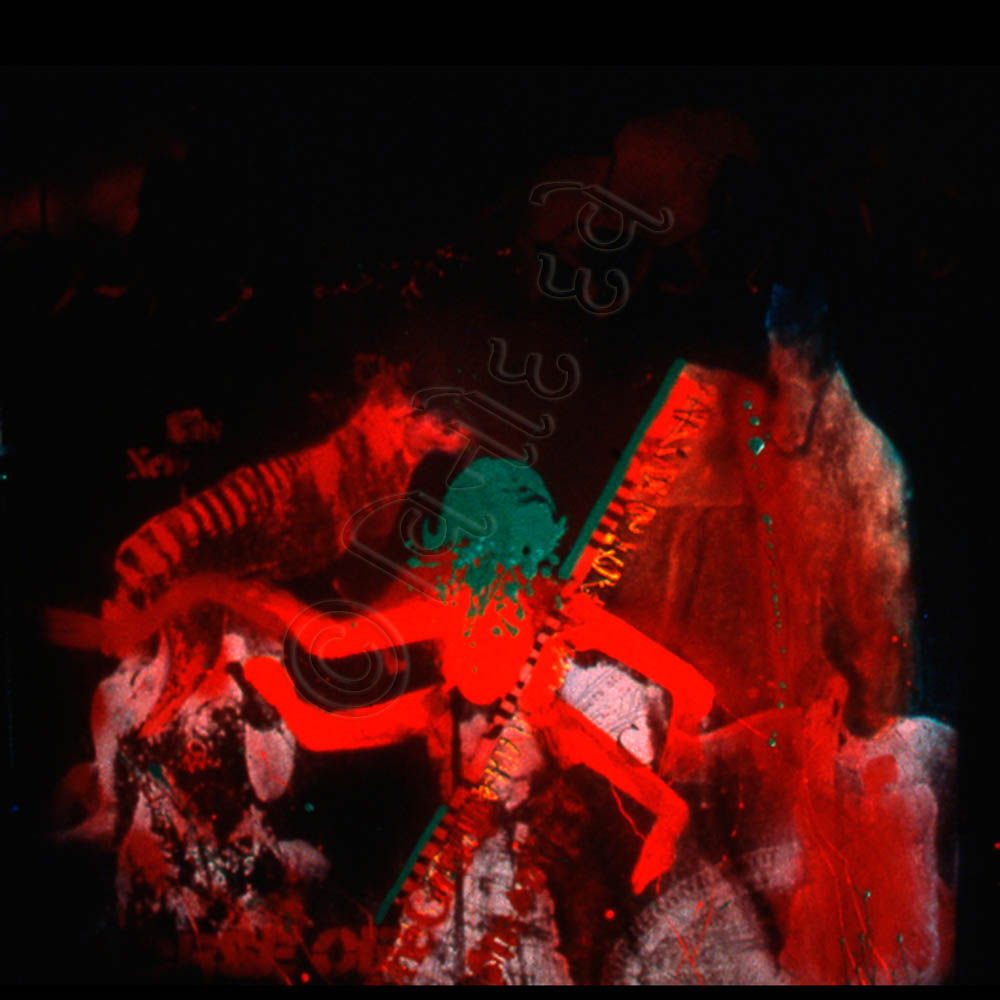
We each morning read and “digest” bad news with breakfast, mostly of violence of humans against humans, while we sit at our breakfast table. Reacting to that, my work involves manipulated re-photography of socially violent news-images in a way that makes the photograph, ‘frozen’ by a photojournalist’s camera, ‘melt’ again to convey a powerfully expressionistic statement about the hard world of relativity that one faces in contemporary global society. Part painting, part photograph, largely dark toned mixed-media work, at first looks like an interestingly patterned abstract pastiche; its figures taken from the news media provide an allegorical puzzle. The puzzle is soon solved with the discovery of my pre-occupation with violence, a violence that can not be categorized and that charges the whole of living. The photographs of a daily variety of ‘human made violence’ juxtaposed with purposeful slashes and strokes punctuate the composition with broken shards and a fragmented imagery that blend, one into the other, regardless of time and form. The news photograph aligned and juxtaposed with slashes and borders of color refer to the human condition. Taken out of context of black and white boxes of columns, print and headlines, the photograph now takes its reference from and has its energy in suggestive potentiality of color.
CRITICS' REVIEWS ON PHASE 2
Vinod Dave’s work is informed with an unusual perception and a unique sensitivity to his medium. His work is imbued with a strong emotional intensity which is rendered means of rich color sense that speaks of both Western and Eastern influences. The intensity of his artistic voice speaks to everyone.
His The Green Empire of Her Psychosis, certainly recalls the Western collage tradition beginning with the work of Kurt Schwitters and continuing to Dada photographer Hans Bellmer. The composition as a whole alludes to the decorative planarity of Rajput and Mewar miniature, while the surface graffiti recalls tribal wall paintings, such as produced by the Warli painters. The reclining nude repoussoir figure recalls both the legion of the Western odalisques as well as the sensuous sacred figures of Eastern religious sculpture. Dave’s choice of the photographic medium finds its source in late Victorian portraits copied from photographs, or actually painted upon them. Commenting about these palimpsest images, Stuart Cary Welch states, “Such was their skill that it is often challenging to be sure whether or not some paintings are fundamentally what they seem.” The same could be said about Vinod Dave’s work.
The magic fiery nature of modern-day Indian art is lighting up two galleries and a corridor at the Worcester Art Museum. Blazing colors, abstract imagery but also delicately drawn figures mark this show, the second the museum is devoting to contemporary Indian art. The oldest is Msqbool Fida Huasain. In this show, it is not Husain but Vinod Dave who carries the day. Dave’s mixed-media works light up the museum’s Fountain Gallery with their brilliant color schemes. Like an old master painter, he uses lots of bright reds and deep greens and other warm hues to focus attention on his collage-like scenes. Surrounding areas are in subdued hues or semi-darkness. His imagery is composed out of different objects. People, animals, architectural elements and scenes from contemporary life are joined into an electrifying whole. There is an unreal character to it, as if the artist has joined flashes from dreams in an effort to piece together the complete story. His imagery is expressive and powerful and cleverly combines reality with abstract. The impact is heightened by the scale of the works even though Dave shows himself no less effective in his smaller mixed-media works.
-Peter Donker
PHASE 2 IMAGES


PHASE 1 : EARLY WORKS - 1975-1981
IMPORTANT NOTE
[During this phase, I had two eyes. I lost one of the eyes in an accident before beginning of 2nd phase of my art career. So there is a difference in my way of painting before and after. This phase shows how an artist with both good eyes would see depth/volume & translate them in works of visual art. All the phases after this one show how a one-eyed artist would struggle to invent a feeling of depth via juxtaposition of conflicting/contrasting elements. For full explaining statement, read it at the beginning of the post about phase 3.]
ARTIST'S STATEMENT ON PHASE 1
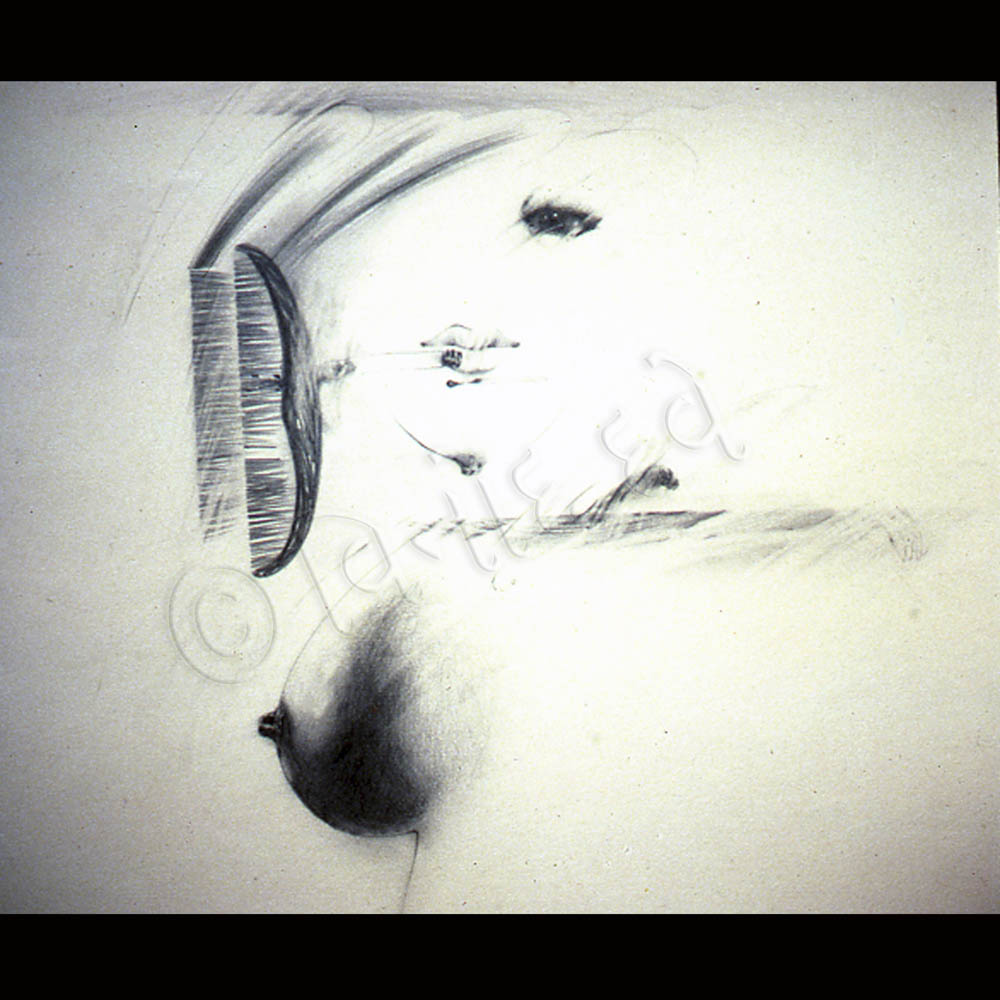
My drawings, at least in the beginning, were concerned with emptiness and desolation. This feeling is a personal one. I found the image of a bat in a forlorn room an effective symbol of this. A bat hanging from a ceiling forebodes helplessness and death. When it flaps about blindly in a room, it carries this feeling with it.
The image of a bat, a small living thing with enormous wrappings led me into other metamorphic forms. These combined them in a way that showed a struggle between the inert and the active. This led me in its turn to pictures of erotic combat, sometimes combining the sensual and the brutal. I have probably tried to dramatize through these a feeling of personal desolation. I have probably tried to make a general comment to an environment which is a thing to us. We struggle to be a part of it but not be a thing ourselves. I am aware of an inherent contradiction like this in life, even the erotic.
My drawings have been so far quite personal, but of late, I have wanted to pull myself out of it into a distance and be a watcher not a party.
CRITCS' REWIEWS ON PHASE 1
Vinod Dave’s confiding note on his drawings is illuminating. It is disturbingly frank, as are his drawings. Handling a vast variety of forms – the bat, the nude, the disembodied garment – Dave’s delineation is so clear and aggressive, so sudden and striking in confrontation as visual images, that the drawings command immediate attention and respect. The anatomical details are rendered with fine observation and a revealing skill.
Some his works refer to the erotic but manage to avoid portraying the sensual or the sensuous. Dave does this by incorporating graphic elements or themes which make the drawings portray frustrations or mania. Compositions based on the forms of the bat imply and suggest the elastic , nervous power symbolized by this creature.
There is a genuineness about these images, a powerful but controlled statement and an unorthodoxy which mark Vinod Dave as a young artist of considerable talent.
One is immediately struck by Vinod Dave’s skill as draughtsman and painter. He reveals a sure and masterly grasp of pencil and paint. There is a fluidity and ease in the execution of his works, the dexterity and supple grace of the accomplished artist. Art comes naturally to him, it is his element.
But technique apart, Dave has developed a personal imagery which is compelling, with forms as persistent as figures in a dream. They are an assault on the senses, a nightmarish vision of the vampires, dismembered bodies, scattered remains, emptied skins juxtaposed with the cold crystalline hardware of modern life. They are painted with a meticulous almost obsessive realism, reassembled in a relationship which cast the hypnotic spell of the chimera. These disturbing convulsive transfigurations create a Kafkaesque fantasy, suffused in an atmosphere of sinister menace, the corporal elements seemingly victims in an infernal drama.
The drawings have the clinical assurance of the surgeon’s knife. While the pencil exults in the human form, tracing the rounded contours of the body with the lascivious scars, it explores with an unabashed sensuality and limitless curiosity the remotest regions. Side by side with the disjointed images of startling beauty we have the polished gloss of putrefaction, of the bulbous shapes, of tissues tainted with the settling hues of decay.
Whatever the morals of these works, they are evidence of a creative imagination of uncommon power.
We experience hard realities, the stresses in society and the nature of sleep, the sensuous repose of the body, its physical abandon, and the psychic state of the dream when experience is metamorphosed and memory is recast and experienced subliminally as a symbolic narrative while looking at work of Vinod Dave. His work projects both these areas of sensibility, often coalescing the two. The result is real enough to be of this world of phenomenal things and fantastic also in the way that the images are “arrested” images, phased in the rhythm and movement of the dream.
We see this distinctly in the series of drawings depicting a dog on the prowl. By changing the background, which engenders the mood, the expression changes from the sinister to the sad. In a sequence of frames the dog, despite being depicted in the same posture, appears to move on as the eye admits its representative-ness and the mind takes into account its progression.
This lone dog for all its forward thrust is a metamorphosed image. One leg seems rooted, planted, as though animal life were drawing substance from vegetative earth. The cycle is complete, with the dog asleep, under a bed, besides a blanketed figure – both creatures of this world, and out of it as well, at the same time.
Vinod Dave’s other recurring theme is the female nude. Depicted in varying degrees of delineation – sensuously graphic and exquisitely modeled as in the drawings – or transposed and transformed as in the paintings where figure and prop are surreal presences – the nude is the personification of the sleep world, sleep as a sexual encounter and sleep as the drama in the dream.
-Richard Bartholomew
PHASE 1 IMAGES

ARTIST'S BIOGRAPHY
Digital Film-Making, New York Film Academy, New York, 2007. Cibachrome Printing, International Center of Photography, 1990. MA in Mixed-Media, Highest Honors, University of South Carolina, 1984. MFA in Painting, Highest Honors, M.S. University, India, 1976.
Jehangir Art Gallery and Tao Gallery, Bombay 2005; Gallery ArtsIndia, New York 2004; Gallery Sumukha, Bangalore 2003; Apparao Galleries, Bombay, Madras and New Delhi 2000; Bose Pacia Modern, New York City 1998; Gallery 7, Bombay and Vadehra Art Gallery, New Delhi 1997; Gallerie 24, The Hague 1994; Center for Contemporary Art, New Delhi 1990; Gallery Chemould, Bombay 1986/1993; Girdharbhai Sangrahalaya Museum, Amreli, India 1987: Contemporary Art Gallery, Ahmedabad 1983; Max Mueller Bhavan, Bombay 1981; Jehangir Art Gallery, Bombay 1980; Hutheesing Visual Art Center, Ahmedabad 1979 Art Heritage Gallery, New Delhi 1978/1982.
GROUP EXHIBITIONS
Mueller-Plate Gallery 10th Anniversary Show, Germany, 2007; ERASING BORDERS - Queens Museum 2006; HOME & THE WORLD - Rutgers University 2005; TIMELESS VISION - Peabody Essex Museum, Salem 1999 & Haggerty Museum, Milwaukee 2000; KALIGHAT PAITING - Los Angeles County Museum of Art 1999; EPIC REALITY - Houston Contemporary Art Museum 1997; THE OTHER WAY OF SEEING - Museum voor Volkenkunde, Rotterdam 1992; SOUTH OF THE WORLD - Galleria Civica D’Arte Contemporanea with Museo Civico, Milan 1991; CHINA-JUNE 4 - P.S. 1 Museum, New York 1990; ARTIST IN MARKETPLACE - the Bronx Museum 1988; FLAMES OF INDIAN ART - Worcester Art Museum 1986 & FESTIVAL OF INDIA exhibitions - NYU’s Grey Art Gallery, Bucknell University’s Center Art Gallery, Robert Hull Fleming Museum & Hood Museum 1985-1986.
AWARDS/GRANTS/FELOOWSHIPS
Pollock-Krasner Foundation, 2013; Joan Mitchell Foundation 2013; Gottlieb Foundation 2011; Beaumont Foundation of America Technology 2003; New York Foundation for the Arts 2002; New York Association for New Americans 2001; Pollock-Krasner Foundation 1994; The New York Foundation for the Arts 1990; Gottlieb Foundation 1990; Asian Cultural Council 1983; MicKissick Museum Award 1983; Research Fellowship of Lalit Kala Akademi, New Delhi 1980; The Culture Ministry of India 1975; OASIS Award 1976..
My art works are in the following collections: National Lalit Kala Akademi; Gujarat State Lalit Kala Akademi; Punjab University Museum; Lintas India; Tata Corporation; Max Mueller Bhavan; Swedish Embassy; Museum voor Volkenkunde, Rotterdam; Peabody Essex Museum; Lufthansa German Airlines; Asian American Arts Center; Asian Cultural Council; Darpana Dance Academy, India; Haryana State Tourism Corporation; Chester and Davida Herwitz Trust; The Alkazi Collection and private collections.
HOME AND THE WORLD, Cambridge Scholars’ Press 2007; CONTEMPORARY INDIAN ART – Other Realities, Marg Publication, 2002; COMERADES AT ODDS, Cornell University Press 2000; CONTEMPORARY ART IN BARODA, Mapin Publication 1997; CONTEMPORARY INDIAN ART, NYU Press 1985; FESTIVAL OF INDIA, Harry N. Abrams 1985 & in art journals (SPAN magazine, BLACK & WHITE magazine, Marg, ART Asia Pacific, Asian Art News, Flash Art, Art in America, ART India, FOTOart) & various museums/auctions houses/galleries catalogues.
Asia Society 1984. Asian American Arts Center 1998. Visiting lectures - National Institute of Design, Ahmedabad, 1979; & School of Visual Arts, New York, 1993. Directed camps at the Yoga Retreat, Stroudsburg, 1986-1991. Professor of Art - C. N. College of Fine Arts, India, 1977-1982. Art workshops - Gujarat State Lalit Kala Akademi, 1978-1981.
AUCTIONS
Sotheby’s, Christie’s, CRY Foundation, South Asia Against AIDS Foundation & Pakistani Literacy Fund, 1995-2000.
RESEARCH
Wrote two masters’ theses: Visions of the Essence 1984. Surrealistic and Expressionistic Tendencies in Contemporary Indian Art 1976.